
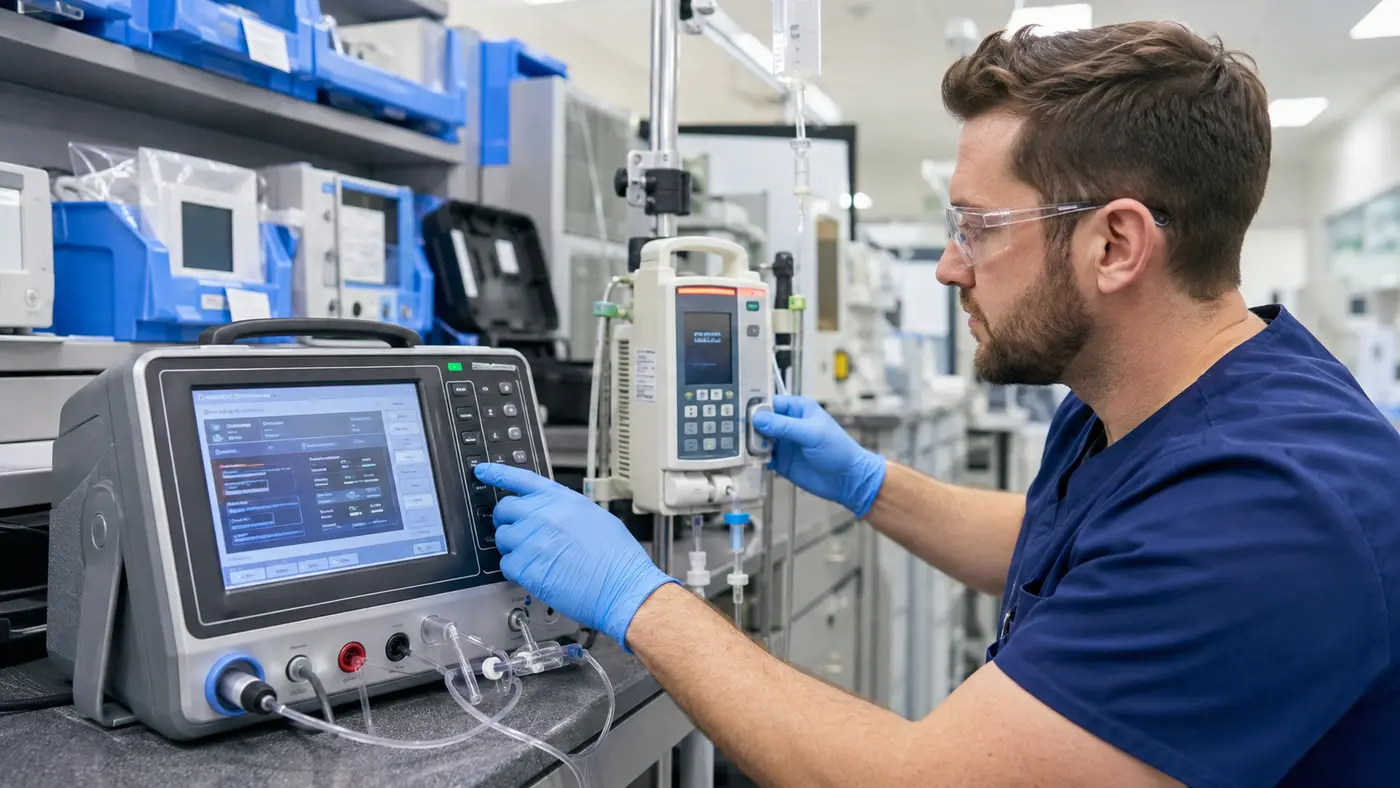
Medical equipment risk classification gives hospitals a structured way to decide which devices require the greatest maintenance attention. A ventilator, infusion pump and examination light should not automatically receive identical maintenance priorities simply because all three appear in the same asset register. Their functions, consequences of failure and service requirements differ substantially.
Risk classification does not replace manufacturer instructions, regulatory requirements or professional judgement. It provides an additional management framework for prioritising work, reviewing maintenance programmes and directing resources toward equipment where failure can have greater consequences.
What medical equipment risk classification should consider
A practical assessment examines more than equipment price. Common factors include the function of the device, potential consequence of failure, preventive-maintenance requirement, environment of use and historical likelihood of failure. The National Health Mission's biomedical equipment guidance also places equipment audit and maintenance planning within a broader equipment-management system.
- Clinical function: life support, therapy, diagnosis, monitoring, laboratory analysis or general support.
- Failure consequence: what could happen if the device fails or performs incorrectly.
- Maintenance requirement: whether periodic technical intervention is important for continued reliability.
- Use environment: ICU, OT, emergency, laboratory, ward or other setting.
- Failure history: recurring faults, mean time between failures and previous service evidence.
Risk is not determined by price
An expensive asset is not automatically the highest clinical risk, and a relatively inexpensive device is not automatically low risk. The assessment should focus on function and consequence. A small device involved directly in delivering therapy may deserve greater maintenance priority than a costly non-critical support asset.
Create clear high, medium and low categories
Hospitals can translate the assessment into practical categories. The scoring method should be documented and used consistently. Category definitions must be understandable to biomedical engineers, department managers and auditors.
High-risk equipment may include devices whose failure can directly compromise life support, critical therapy or essential monitoring. Medium-risk equipment may affect diagnosis or treatment but have lower immediate consequence or available alternatives. Low-risk equipment generally has limited clinical consequence if unavailable, although it still requires appropriate inspection and maintenance.
These examples are not universal classifications. The same equipment type can carry different operational importance depending on its clinical application, patient population and availability of backup equipment.
Use risk classification to prioritise maintenance, not to skip it
A risk score can help determine which overdue tasks need immediate escalation, but it should not be used as an excuse to ignore manufacturer-prescribed maintenance. Preventive-maintenance frequency should consider manufacturer instructions, applicable requirements, utilisation, environment, service history and the hospital's documented programme.
- Prioritise high-risk overdue preventive maintenance.
- Escalate breakdowns according to clinical consequence.
- Review repeat failures in high-risk categories.
- Ensure suitable backup planning for critical equipment.
- Use risk information during replacement and capital planning.
Review classifications when circumstances change
Risk is not necessarily permanent. A device moved from a general ward to a specialist unit may be used differently. A previously reliable model may develop recurring failures. A backup device may become the department's only available unit. Review the classification when equipment, location, clinical use or service evidence materially changes.
Connect risk scoring with the asset register
Store the assigned risk category against the asset record so it can support maintenance scheduling, breakdown escalation and reporting. Avoid maintaining a separate spreadsheet that quickly becomes inconsistent with the live inventory.
BioMed provides preventive maintenance and biomedical equipment support for healthcare facilities, with service documentation designed around equipment identity and operational needs. Hospitals can discuss a maintenance scope through the BioMed contact page.
A useful medical equipment risk classification system makes maintenance priorities visible and explainable. By combining clinical function, consequence of failure, maintenance need, environment and reliability history, hospitals can allocate technical attention more intelligently while keeping manufacturer requirements and professional judgement at the centre of the programme.