
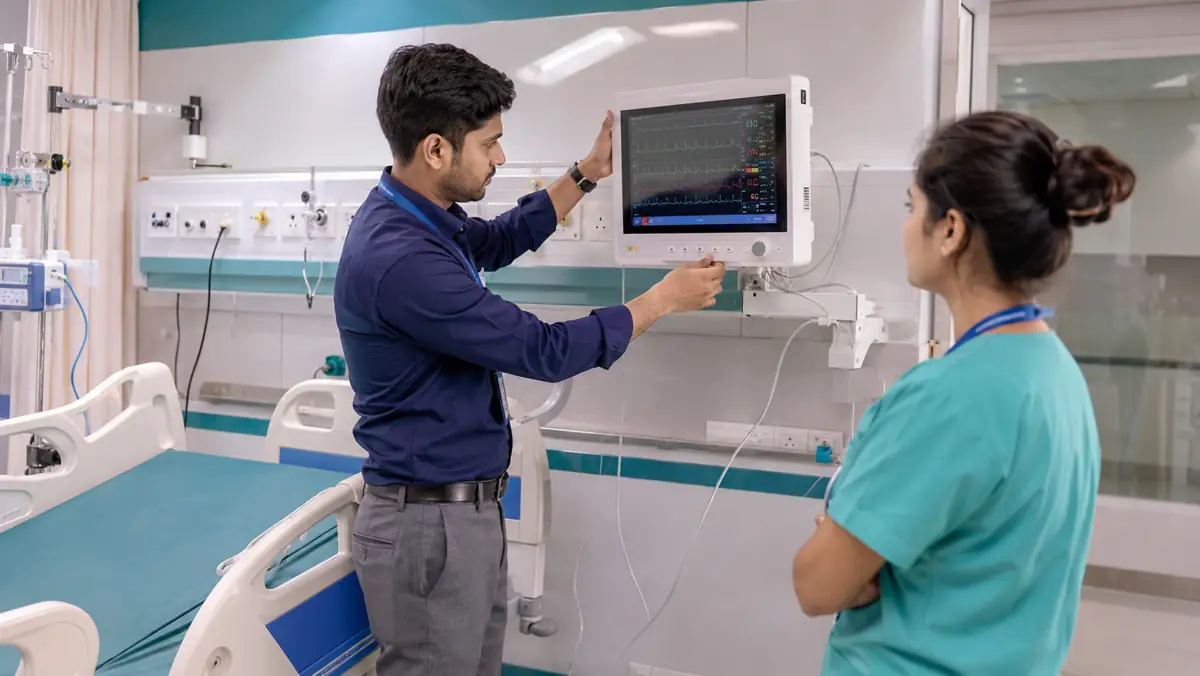
A medical equipment procurement checklist helps a hospital move beyond price comparison and make a defensible clinical, technical and financial decision. A device that looks economical at quotation stage can become expensive if accessories, installation requirements, service support, consumables, calibration, software licences or replacement parts were not considered before purchase.
Good procurement therefore begins with the clinical requirement, not with a catalogue. Biomedical engineering, the user department, procurement, finance, facilities and information technology should contribute where the equipment affects their responsibilities. The objective is to purchase equipment that is appropriate for its intended use, supportable through its working life and ready for safe acceptance into the hospital's asset system.
Medical equipment procurement checklist before requesting quotations
Define what problem the equipment must solve. Record expected patient volume, department, intended clinical application, operating hours, required capacity and any essential compatibility with existing accessories or systems. Avoid writing a specification around a preferred brand unless there is a documented technical reason.
- Confirm the clinical need and expected workload.
- Identify essential performance requirements separately from desirable features.
- Check room dimensions, access route, power, earthing, ventilation, gases, water, drainage and network needs.
- List required accessories, probes, batteries, cables, licences and starter consumables.
- Decide who will operate, clean, maintain and technically support the equipment.
The Government of India's National Health Mission guidance on equipment maintenance emphasises planned inventory management, maintenance, calibration and equipment audit as parts of effective equipment management. Procurement decisions should anticipate these lifecycle responsibilities rather than treating them as post-purchase problems.
Write specifications around outcomes and measurable requirements
A useful specification describes required functions, performance ranges, safety or quality requirements, accessories, documentation, warranty, installation, training and service expectations. Where applicable, ask bidders to identify regulatory status and provide supporting documents appropriate to the device category.
Be careful with vague terms such as premium, advanced or latest. They are difficult to evaluate objectively. Measurable requirements make technical comparison clearer and reduce the risk of receiving a device that technically matches a quotation but does not suit the department.
Compare total cost, not purchase price alone
Purchase price is only one component of ownership. Hospitals should estimate recurring consumables, preventive maintenance, calibration, batteries, sensors, accessories, software, annual support, likely spare parts and expected useful life. For some devices, consumables and service costs over several years can materially exceed the initial price difference between two options.
- Equipment price and applicable taxes
- Freight, installation and commissioning
- Accessories and initial consumables
- Warranty scope and exclusions
- AMC or CMC cost after warranty
- Calibration and periodic testing requirements
- Software subscriptions, licences or connectivity charges
- Expected spare-part availability and lead times
Ask vendors to state these items separately. A transparent lifecycle comparison is more useful than choosing the lowest initial quotation.
Evaluate the supplier and service capability
Technical support becomes important after the purchase order is closed. Confirm who will install the device, who provides warranty service, where engineers are located, what escalation path exists and how parts are obtained. Ask for realistic response arrangements rather than accepting broad promises of immediate support for every fault.
For critical equipment, consider whether the supplier can provide temporary support, replacement accessories or other continuity arrangements when a repair requires extended downtime. Review the proposed preventive-maintenance schedule and the service documentation that will be issued.
Plan delivery, installation and acceptance before dispatch
Site readiness should be completed before the equipment arrives. On delivery, match the model, serial number, quantity and accessories with the purchase order and packing list. Record visible damage or missing items. Installation should follow manufacturer requirements and be performed by appropriately authorised personnel.
Acceptance should verify the functions and deliverables defined in the purchase order. Depending on the device, this can include functional checks, safety checks, calibration evidence, configuration, connectivity, accessory verification and user orientation. Manuals, warranty documents, licences and service contacts should be handed over before closure.
Add the equipment to the asset system immediately
Assign an asset identifier and record manufacturer, model, serial number, location, acquisition date, warranty period, service provider and maintenance requirements. This creates the starting point for future preventive maintenance, calibration, repair history and replacement planning.
BioMed supports healthcare facilities with medical equipment supply and lifecycle services, including requirement assessment, installation coordination and maintenance planning. Hospitals can share a requirement through the BioMed contact page for a scope-based discussion.
A disciplined medical equipment procurement checklist protects more than the purchasing budget. It connects clinical need, technical suitability, infrastructure, serviceability and lifecycle cost before a commitment is made. That makes procurement easier to defend and gives the hospital a stronger foundation for reliable equipment management after installation.